A basement doesn’t have to flood to suffer moisture damage. Sometimes, the biggest threat is the humidity you can’t see.
Throughout Rochester, Buffalo, and Western New York, homeowners regularly deal with damp basement air, musty odors, and condensation. While these problems may seem minor, persistent humidity can contribute to mold growth, damaged belongings, and deteriorating building materials.
A properly sized basement dehumidifier can make a significant difference. However, not every dehumidifier is equipped to handle the same conditions.
How Excess Basement Humidity Threatens Your Home
Basements naturally collect moisture because they’re surrounded by soil and often remain cooler than the rest of the house. When humid air encounters cold basement walls, pipes, or flooring, condensation can develop.
According to the Environmental Protection Agency (EPA), indoor relative humidity should remain below 60%, ideally between 30% and 50%.
Consistently exceeding those levels can lead to:
-
Mold and mildew: Damp conditions encourage microbial growth on susceptible materials.
-
Wood deterioration: Excess moisture can damage framing, subfloors, and stored furniture.
-
Unpleasant odors: Persistent mustiness can spread into upstairs living areas.
-
Property damage: Moisture can ruin cardboard boxes, clothing, documents, and finished basement materials.
Preventing these problems helps protect your investment and preserve the condition and usability of your home.
Standard vs. High-Capacity Basement Dehumidifiers
A portable dehumidifier purchased from a hardware store may be perfectly adequate for a small basement with occasional humidity problems.
However, homeowners with larger basements or persistent moisture often discover that portable units struggle to maintain comfortable humidity levels.
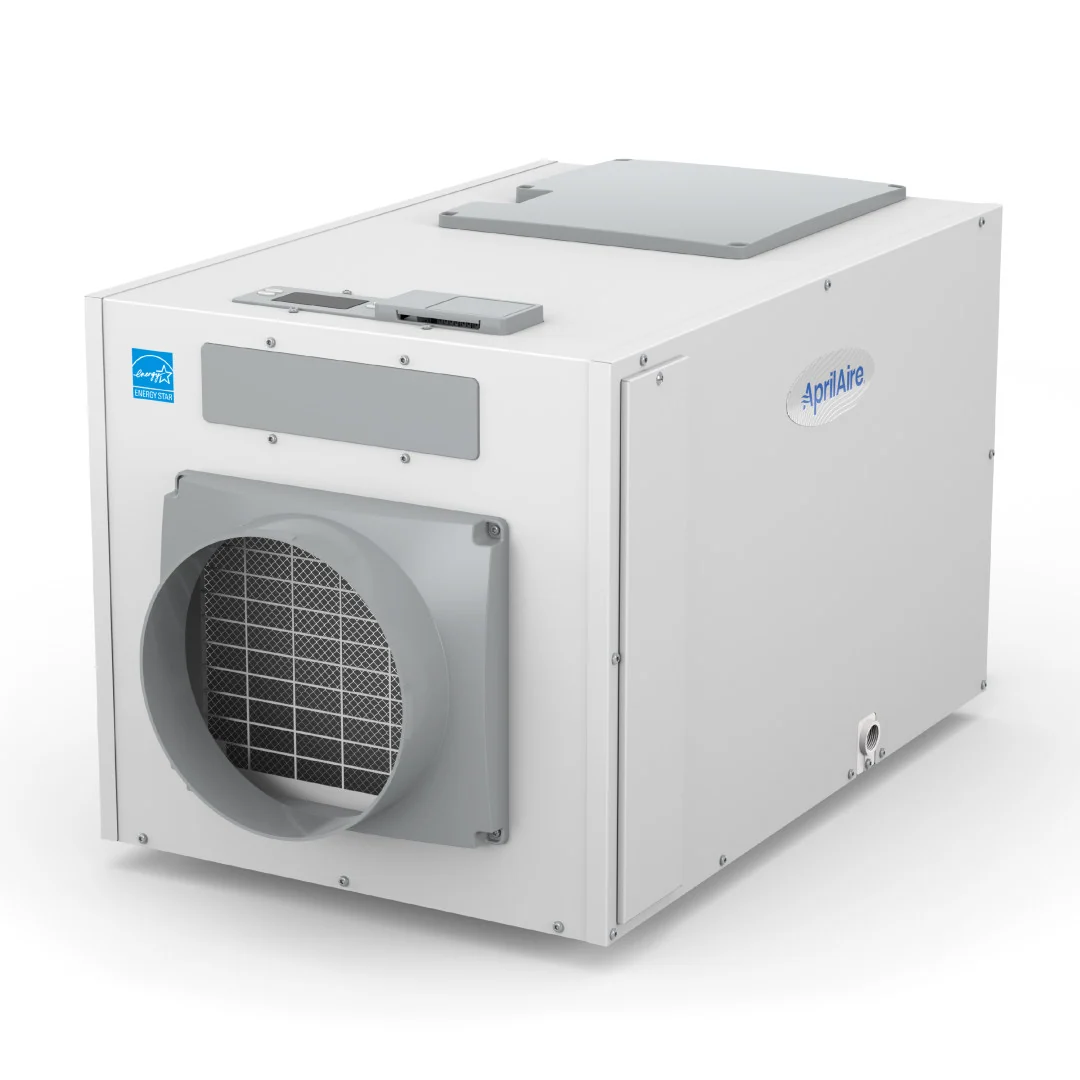
High-capacity systems, such as those manufactured by AprilAire, offer substantially greater moisture-removal capacity and options for continuous drainage and ducted air distribution.
Comparing Dehumidifier Performance
| Dehumidifier | Rated moisture removal | Energy efficiency (IEF) |
|---|---|---|
| Typical portable unit | 25–50 pints/day | Varies by model |
| AprilAire E080 | 65 pints/day | 2.35 L/kWh |
| AprilAire E100 | 85 pints/day | 2.35 L/kWh |
| AprilAire E130 | 105 pints/day | 2.35 L/kWh |
AprilAire figures reflect published ENERGY STAR ratings. IEF measures liters of water removed per kilowatt-hour consumed. Portable and whole-home ratings use different test conditions, so their efficiency figures should not be treated as directly interchangeable.
Higher capacity doesn’t automatically mean better performance for every basement. Choosing the right system depends on square footage, moisture conditions, airflow, and the amount of water that needs to be removed.
Why AprilAire Dehumidifiers Are Worth Considering
For homeowners dealing with ongoing basement humidity, AprilAire offers several advantages over basic portable units.
Their high-capacity models feature automatic humidity controls, continuous drainage capabilities, and designs suitable for demanding basement environments.
That means less attention spent emptying collection buckets and more consistent humidity management.
AprilAire’s E080, E100, and E130 models are also ENERGY STAR certified, making them attractive choices for homeowners concerned about energy consumption.
Rather than relying on a small appliance to manage a substantial moisture load, homeowners can invest in a properly sized system designed for more extensive, long-term dehumidification.
Dehumidifiers Work Best Alongside Proper Waterproofing
There’s one important limitation homeowners should understand: A dehumidifier cannot fix a water leak.
If groundwater is entering through foundation cracks or accumulating beneath your basement floor, removing humidity from the air won’t eliminate the underlying problem.
Effective moisture protection may require basement waterproofing, foundation repairs, or sump pump installation alongside dehumidification.
Addressing both liquid water intrusion and airborne moisture provides a more comprehensive solution.
Professional AprilAire Installation in Rochester and Buffalo
Since 2015, BelowDry Basement Waterproofing has helped Western New York homeowners address basement moisture problems.
We provide AprilAire dehumidifier sales and professional installation, helping customers choose equipment suited to their particular basement conditions.
Whether you need a high-capacity dehumidifier, sump pump repairs, or a complete basement waterproofing solution, our team can help you identify the right approach.
Call BelowDry Basement Waterproofing to learn more about AprilAire dehumidifier installation in Rochester, Buffalo, and the surrounding communities.